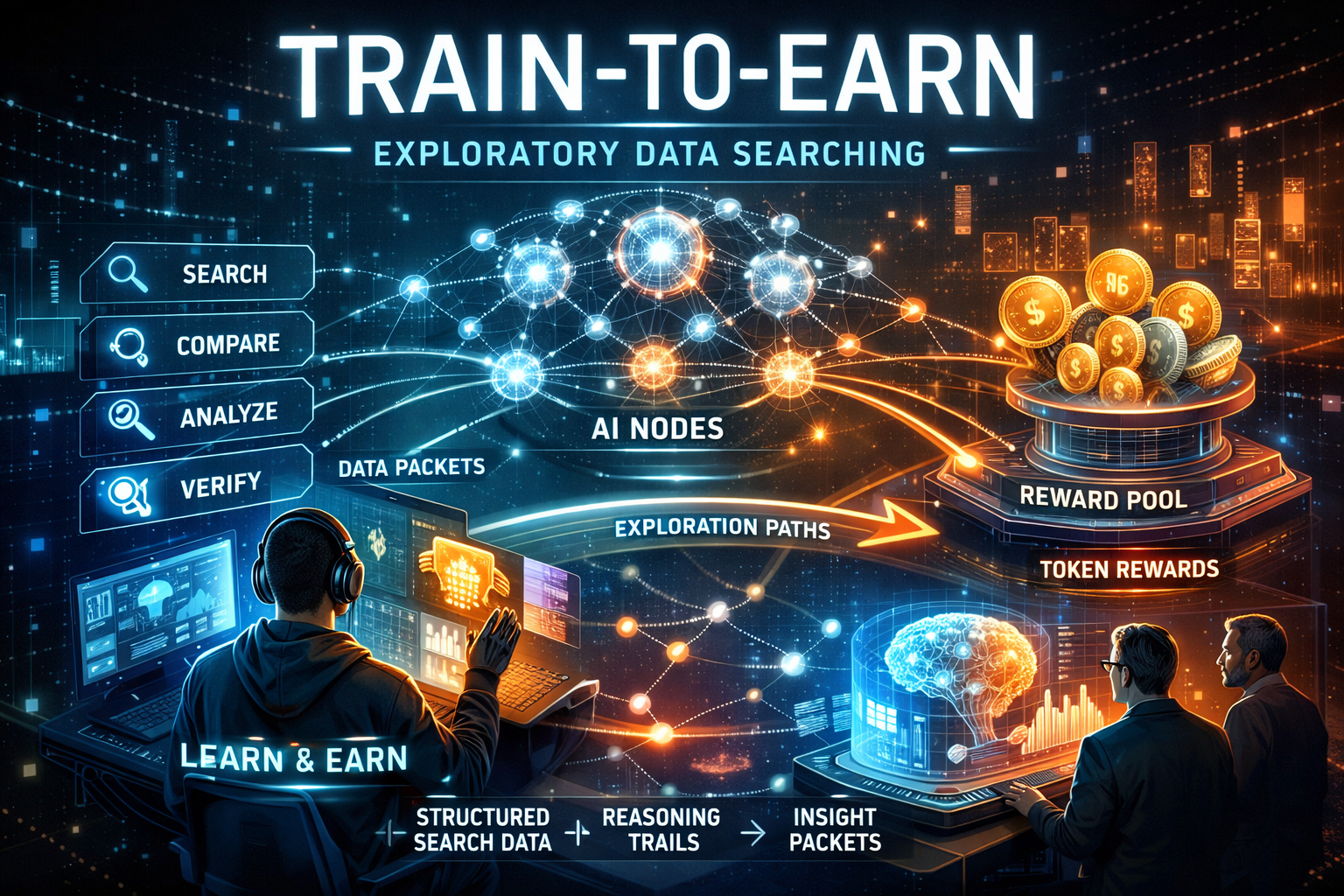
What if searching the internet wasn’t just about finding answers—but about training intelligence and earning value along the way?
As decentralized physical infrastructure networks (DePIN) mature, a new opportunity is emerging at the intersection of AI nodes, structured online exploration, and human-in-the-loop data training. This isn’t just about compute or storage anymore—it’s about how humans and machines co-create data patterns, and how those patterns can become monetizable assets.
Welcome to the idea of sequenced exploration as infrastructure.
From Passive Search to Active Exploration
Traditional search engines optimize for retrieval: type a query, get a ranked list, move on. But AI systems don’t just need answers—they need contextual pathways:
• Why a user searched something
• What they clicked next
• How concepts evolved across a session
• Which sources were trusted, ignored, or contradicted
These sequences are far more valuable than isolated data points.
Now imagine if exploration itself—clicks, refinements, comparisons, dead ends—was structured, anonymized, and streamed into AI training pipelines via decentralized nodes.
That’s where DePIN enters the picture.
AI Nodes as Exploration Routers
In this speculative model, AI nodes aren’t just compute workers. They act as exploration routers:
• Capturing ordered search and discovery paths
• Hashing and encrypting them into data packets
• Tagging them with semantic metadata (intent, domain, confidence)
• Broadcasting them into decentralized training pools
Each node becomes a translator between human curiosity and machine learning needs.
Instead of scraping the web blindly, AI models learn from how humans actually navigate knowledge.
Structured Sequenced Searches: The Missing Dataset
Large models struggle with:
• Causality
• Reasoning chains
• Cross-domain synthesis
Humans naturally solve these through exploration sequences:
“I searched A → realized it was incomplete → compared B and C → trusted D → rejected E.”
If those sequences are structured—time-ordered, domain-labeled, and context-preserving—they become high-signal training data.
Think of them as:
• Cognitive trails
• Reasoning maps
• Exploration graphs
DePIN makes it possible to collect this without central platforms owning it.
Human–Machine Data Packets as an Asset Class
Here’s the key shift:
Data packets aren’t raw data—they’re trained experiences.
A single packet might include:
• Search intent embedding
• Exploration sequence graph
• Source credibility weighting
• Outcome confidence score
These packets can be:
• Sold to model trainers
• Used to fine-tune vertical-specific AI (legal, medical, mechanical, finance)
• Staked for ongoing yield as models continue learning from them
Humans earn not for attention—but for participation in intelligence formation.
Earn Models in a DePIN Exploration Network
Speculatively, value flows could look like this:
1. Users opt into structured exploration modes
2. AI nodes validate, compress, and anonymize sequences
3. Networks reward nodes and users via tokens or stable value
4. Model builders pay to access curated exploration datasets
Earning scales with:
• Complexity of exploration
• Domain expertise demonstrated
• Novelty of discovered pathways
In other words: better thinking earns more.
Why DePIN Is Critical (Not Optional)
Centralized platforms can’t credibly do this without:
• Owning the data
• Exploiting users
• Creating opaque incentives
DePIN introduces:
• Transparent reward logic
• User-owned data trails
• Open standards for exploration packets
• Interoperable AI node marketplaces
It turns infrastructure into a neutral layer for intelligence exchange.
The Bigger Picture: Training the Way Humans Think
This model hints at something deeper than monetization.
Instead of forcing humans to adapt to AI interfaces, AI systems begin adapting to human reasoning patterns—how we search, doubt, iterate, and decide.
Exploration becomes:
• A learning signal
• A training primitive
• A decentralized economic activity
And AI stops being trained on humanity, and starts being trained withhumanity.
Final Thought
The next wave of DePIN won’t just power machines—it will encode human curiosity into infrastructure.
If we get it right, searching the web could become:
• A way to explore
• A way to teach machines
• And a way to earn—fairly, transparently, and collaboratively