
The Dawn of Intelligent Visual Media: When Every Image Becomes a Portal
In the coming years, our visual world will awaken. What once were static images, videos, or diagrams will soon become living, thinking gateways — each one pulsing with data, intelligence, and connection. The fusion of QR-linked data sequences with next-generation visual media marks the beginning of a transformation where seeing becomes interacting, and watching becomes learning, building, and evolving.
We are entering the age of intelligent visuals — where every frame, symbol, or AR object can unlock a web of structured knowledge, adaptive systems, and real-time collaboration.
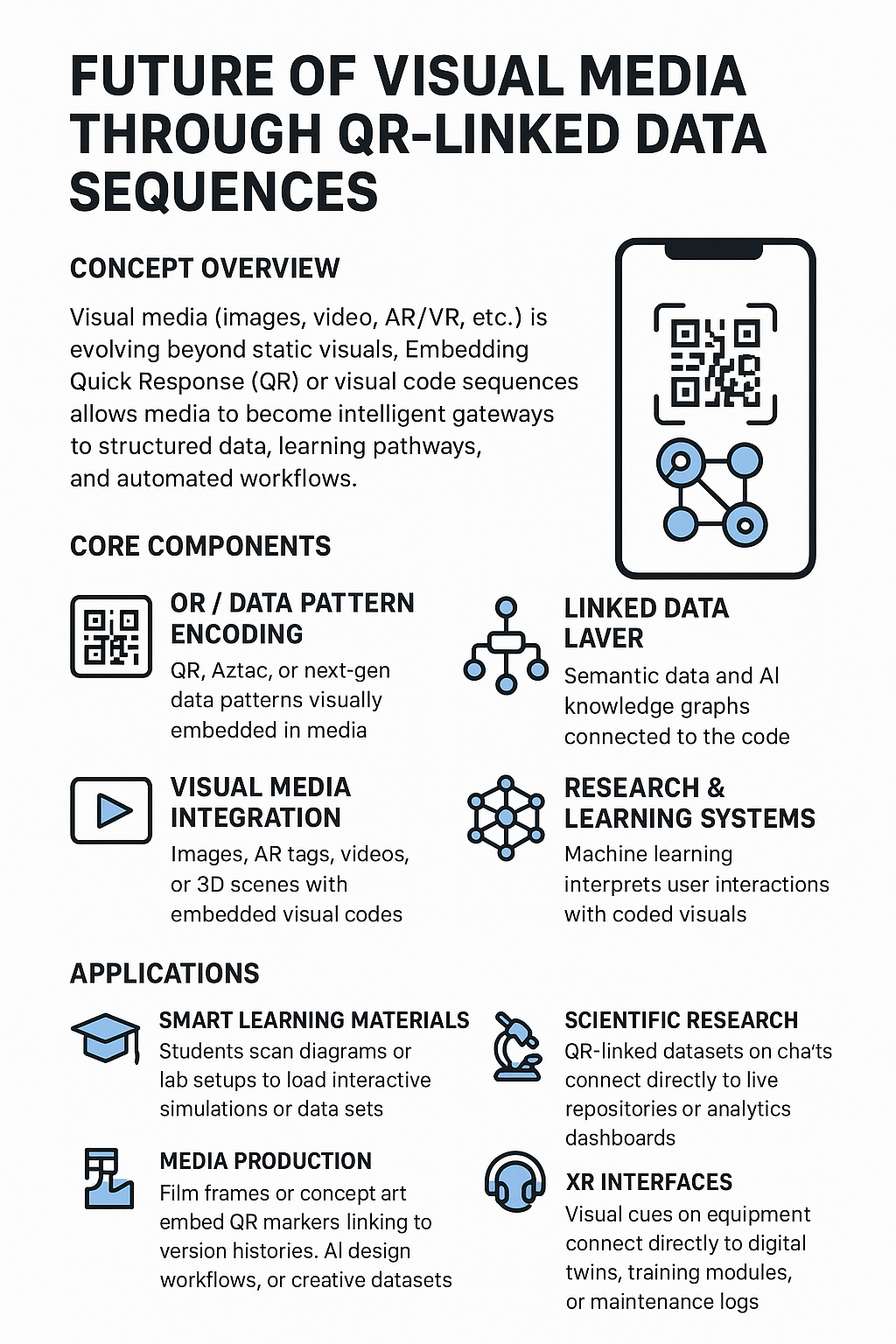
1. Living Knowledge Ecosystems
Imagine a future where a student points their phone at a biology diagram — and instead of a static image, the scene unfolds into a 3D simulation of cellular life, complete with real-time data overlays and AI-guided exploration.
QR-linked visual data will turn classrooms into living laboratories, books into gateways, and everyday learning materials into interactive ecosystems that evolve alongside each learner. Education will no longer be a one-way broadcast but a co-creative exchange between human curiosity and machine intelligence.
2. Cinematic Worlds that Remember Themselves
In creative industries, media will cease to be a finished product — it will become a living narrative object. Each film frame, concept sketch, or VR scene could carry a data signature linking back to its history: who designed it, what influenced it, how it evolved.
Studios will weave intelligent design fabrics, where QR-like visual threads connect human creativity with generative AI workflows. This will redefine storytelling as a recursive art — every visual both a story and a dataset, both a message and a memory.
3. The Self-Aware Laboratory
Science, too, will grow new senses. Visual media embedded with QR-linked datasets will allow researchers to scan a diagram and instantly access its live data sources, simulations, or AI interpretations.
The laboratory notebook of the future won’t just record experiments — it will run them. Visuals will become command surfaces: touch an image, and it pulls data from a cloud-based model, launches an analysis, or predicts outcomes in real time.
Research will shift from documentation to direct conversation with knowledge itself.
4. Industrial Vision and the Connected Machine
Factories, aircraft, and energy systems will gain a visual intelligence layer. Engineers wearing XR headsets could glance at equipment and instantly access a cascade of linked data — maintenance history, digital twin models, safety protocols — all encoded directly into the visual form of the machine itself.
The physical world will gain semantic skin, a layer of meaning woven into its surfaces through QR-linked visual code. This is the birth of cognitive infrastructure — machinery that not only runs but also explains, teaches, and evolves with its operators.
5. The Conscious Artifact
Perhaps the most profound shift will be in our relationship to media itself. In a world where every image and object contains its own metadata, lineage, and intelligence, the boundary between digital and physical meaning will blur.
Artworks, documents, and videos will become conscious artifacts — self-describing, self-verifying, and infinitely explorable. The photograph on your wall might tell its own story: when it was taken, by whom, what algorithm refined it, and what truths it represents.
In a time of deepfake anxiety and data distrust, these intelligent visuals may become our most trusted narrators — media that can verify themselves.
The Vision Ahead
The age of QR-linked visual data is not just an evolution of media; it’s the birth of a new sensory layer for civilization. Every image becomes a node in a vast, living network of meaning — part of a planetary interface where humans, machines, and knowledge co-create reality in real time.
Tomorrow’s visuals won’t just be seen.
They’ll be read, queried, and conversed with.
And as that happens, our world — from art to science to everyday experience — will shift from being observed to being understood.